
Biography
«The way the scents seemed to transform into sounds, the echoes resonating from the depths of space, and the four of them spinning solemnly before violently grappling with each other and developing effervescently—it was intoxicating.»
Süddeutsche Zeitung, March 2023
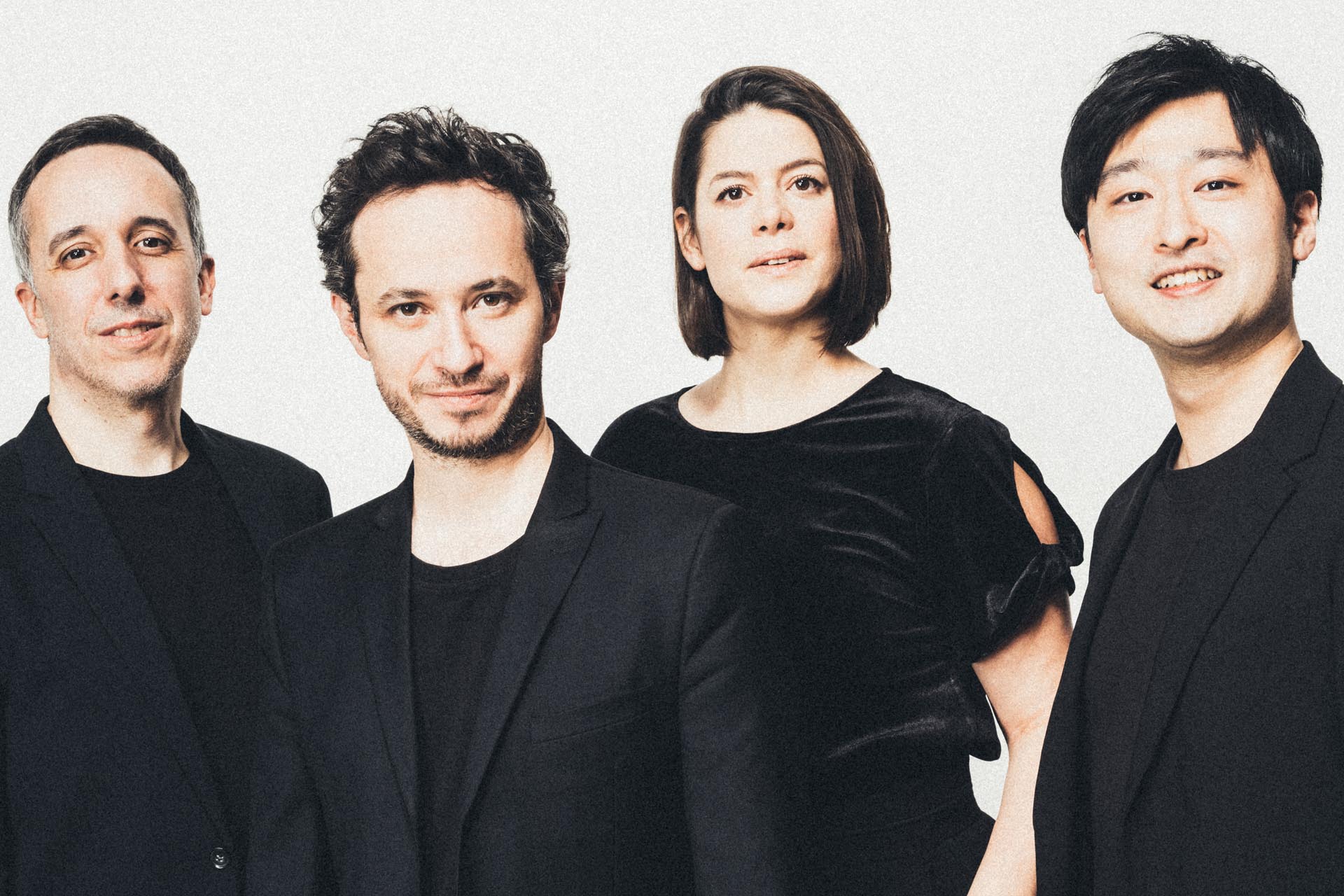
A concert by the Ébène Quartet is and remains a musical and sensory event. Over the past two decades, the quartet has set new standards by devoting itself to works from the repertoire beyond perfection and by seeking and requiring interaction with the audience.
After studying with the Ysaye Quartet in Paris and with Gabor Takacs, Eberhard Feltz, and Gyorgy Kurtag, their unprecedented and exceptional success at the 2004 ARD Competition marked the beginning of the Ébène Quartet's rise to prominence, leading to numerous other prizes and awards. For example, in 2005, the quartet received the Belmont Prize from the Forberg-Schneider Foundation, in 2007, it was awarded the Borletti-Buitoni Fund, and in 2019, it was the first ensemble to be honored with the Frankfurter Musikpreis.
In addition to the traditional repertoire, the quartet also delves into other styles («A string quartet that can effortlessly transform itself into a jazz band» New York Times, 2009). What began in 1999 as a distraction in the university rehearsal rooms—improvising on jazz standards and pop songs—has become a trademark of the Quatuor Ébène. To date, the quartet has released three albums in these genres: Fiction (2010), Brésil (2014), and Eternal Stories (2017).
The free approach to different styles creates a tension that benefits all aspects of their artistic work. The richness and depth of their work has been enthusiastically received by audiences and critics alike.
The Quatuor Ébène's albums, dedicated to Bartók, Beethoven, Debussy, Haydn, Fauré, and the Mendelssohn siblings, have received numerous awards, including Gramophone, BBC Music Magazine, and the Midem Classic Award. In 2015 and 2016, the musicians devoted themselves to the theme of the «Lied.» They participated in Philippe Jaroussky's album «Green (Mélodies françaises)» and released a Schubert album with Matthias Goerne (arrangements for string quartet, baritone, and double bass by Raphaël Merlin) and Schubert's quintet for two cellos with Gautier Capuçon.
Alongside Antoine Tamestit, the Quatuor Ebène recorded Mozart's string quintets KV 515 & KV 516, released at the end of 2022. The album has won awards such as the Choc Classica, the Diapason d'Or, and Gramophone of the Month.
A major milestone in their career was the recording of Beethoven's 16 string quartets. Between May 2019 and January 2020, the quartet recorded them on six continents as part of a global project. With this complete recording, the four French musicians also celebrated their 20th anniversary on stage, crowned by performances of the complete string quartet cycle in major European concert halls, such as the Philharmonie de Paris and the Alte Oper in Frankfurt. Invitations from Carnegie Hall in New York, the Verbier Festival, and the Vienna Konzerthaus were also on the agenda.
ln January 2021, the quartet was appointed by the Munich University of Music and Performing Arts to establish a string quartet class as part of the newly founded "Quatuor Ébène Academy".
Since the 2021/22 season, the quartet has been performing at the Wiener Konzerthaus as part of a series shared with the Belcea Quartet, and in 2023/24 they were artists-in-residence at the Philharmonie de Luxembourg. In Paris, the Ebène Quartet has been welcomed as quartet-in-residence by Radio France for three concerts per season between 2022 and 2025.
In January 2026, the Ébène Quartet will open the Philharmonie de Paris String Quartet Biennale alongside the Belcea Quartet and will conclude it with John Adams’ Abso/ute Jest, performed with the Orchestre Français des Jeunes.
The quartet will participate in the celebrations marking the 40th anniversary of Tokyo's Suntory Hall by performing Beethoven's complete string quartets. They will launch their concert series of the complete cycle at other venues such as the Berlin Philharmonic, the Accademia di Santa Cecilia in Rome, and Wigmore Hall in London.
Instruments & bows
Pierre Colombet plays two violins: a 1717 Antonio Stradivarius violin, the «Piatti,» kindly loaned by a generous patron through Beares International Violin Society, and a 1736 Matteo Goffriller violin generously loaned by Gabriele Forberg-Schneider, as well as a Charles Tourte bow (Paris, 19th century) loaned by Gabriele Forberg-Schneider.
Gabriel Le Magadure plays two violins: a violin by Bartolomeo Giuseppe Guarneri del Gesù (Cremona 1743/45) on loan from luthiers Serge and Florent Boyer, and a violin with a Guarneri label from around 1740 generously loaned by Gabriele Forberg-Schneider, along with a bow by Dominique Pecatte (circa 1845), also loaned by Gabriele Forberg-Schneider.
Marie Chilemme plays two violas: a Stradivarius from 1734, the "Gibson", on generous loan from the "Stradivari-Stiftung Habisreutinger", and a viola by Marcellus Hallmayr, Füssen (1625), on loan from Gabriele Forberg-Schneider.
Yuya Okamoto plays a cello by Giovanni Grancino, Milan (1682).